ThePattern#A003EN — The Shock of 44 Percent Is the Real Warning Sign
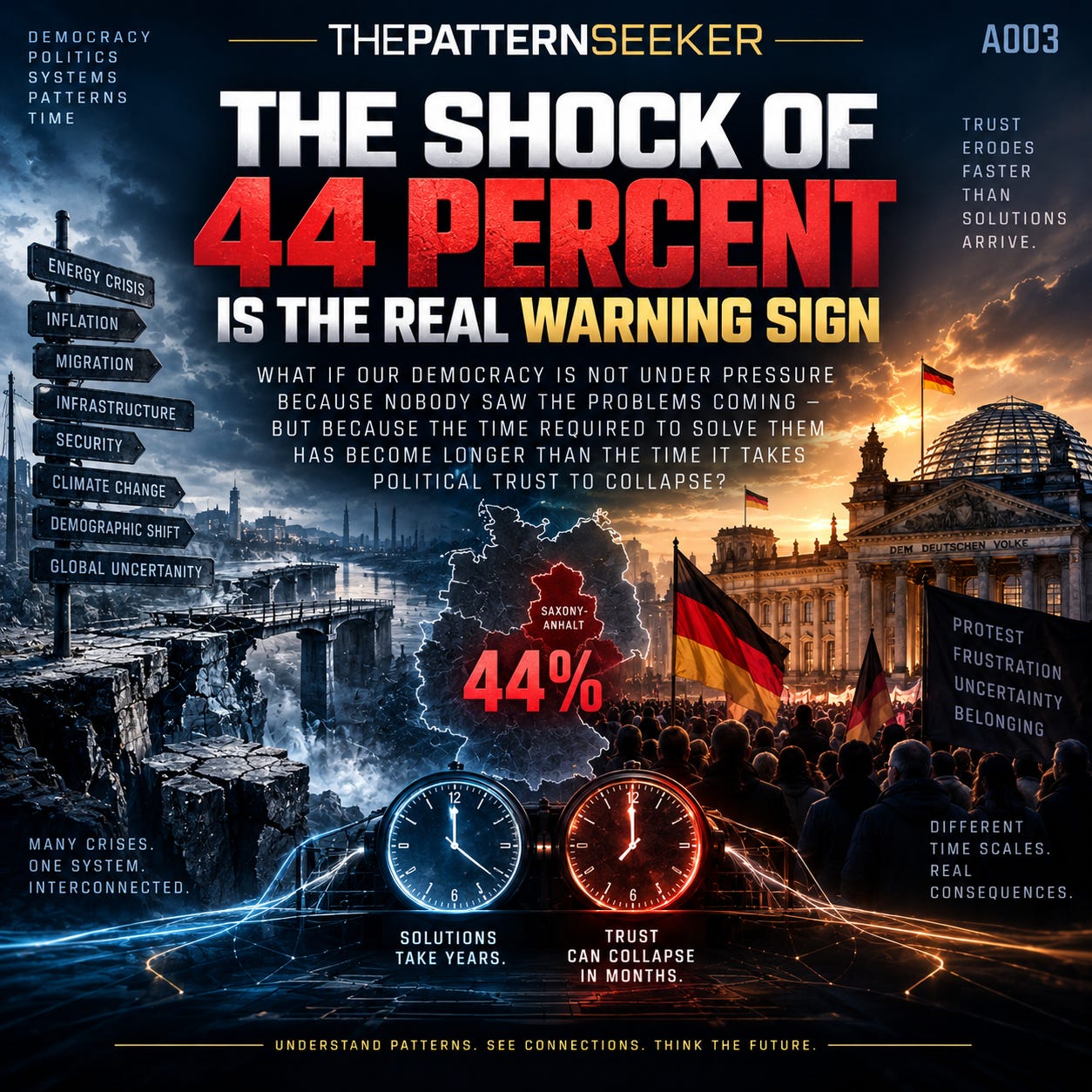
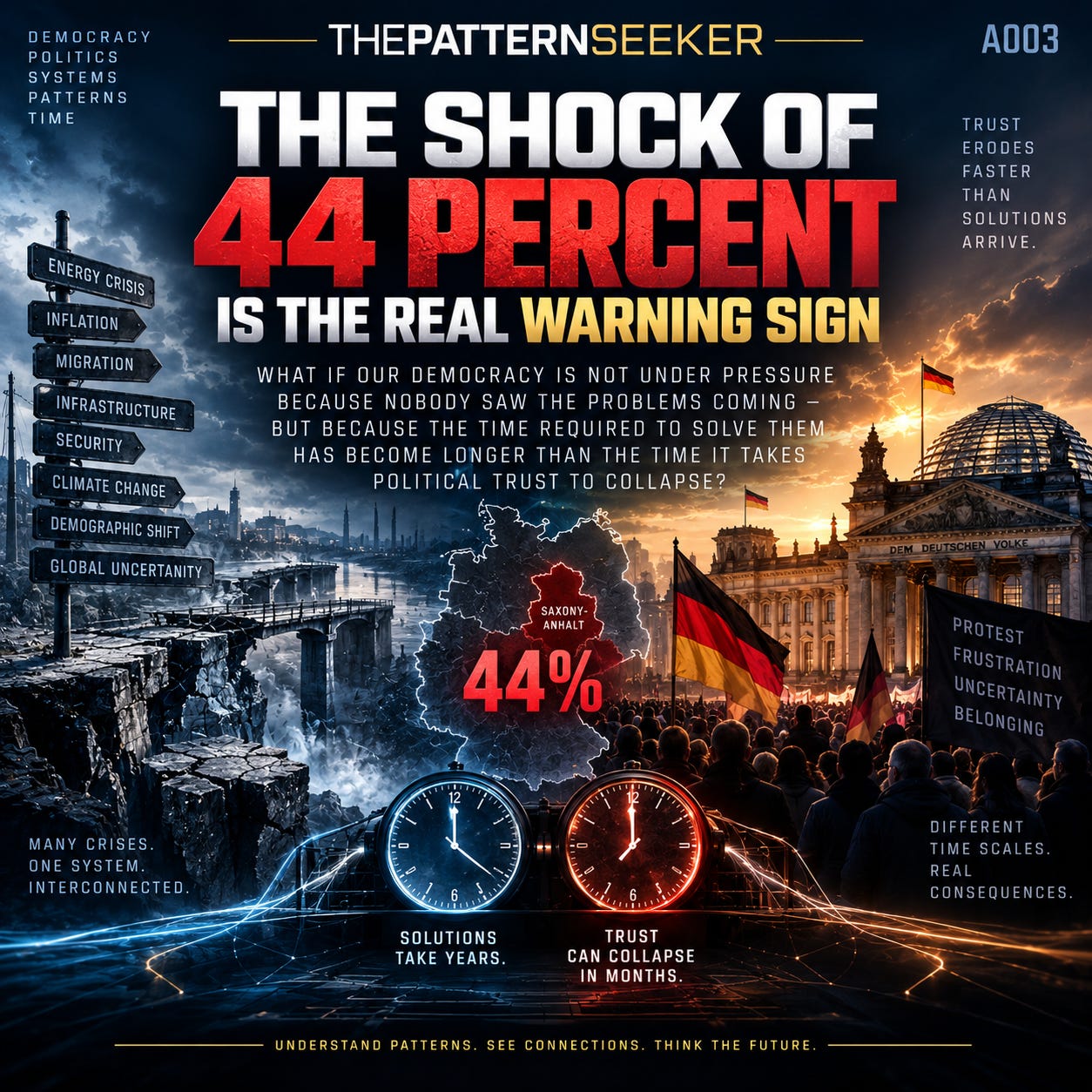
What if our democracy is not under pressure because nobody saw the problems coming — but because the time required to solve them has become longer than the time it takes political trust to collapse?
Almost 44 percent for the AfD in Saxony-Anhalt, and suddenly large parts of the political public sphere are reacting as though the structural foundations of the republic had shifted overnight.
The number itself does not surprise me.
What surprises me is how many people seem surprised by it.
This result did not come out of nowhere. It has been building for years, visible in polling, in economic uncertainty, in growing distrust of institutions, and in a society that increasingly feels as though it is stumbling from one crisis into the next.
A weak economy here, high energy prices there, another fight in parliament, another foreign-policy shock, another migration debate.
Each issue on its own appears manageable.
Only when you begin to connect them does the picture change.
And that is where the more uncomfortable question begins.
«»«»»»»»«»«»»««»«»«»«»«»«»«»
The Comfortable Story of Political Failure
The obvious explanation is that the established parties failed.
They should have reacted earlier, governed better, listened more closely and finally presented the right solutions.
Part of that is true.
Germany allowed infrastructure to deteriorate, delayed digitalisation, underestimated security risks and made its energy supply vulnerable. Many of the decisions whose consequences are becoming visible today go back twenty or thirty years.
But what government, back then, could realistically have told people that a current economic upswing needed to be slowed down because Germany might one day face war, energy crises, climate impacts, demographic pressure and a massive political realignment all at the same time?
That would not have been attractive precaution.
It would have been expensive — and it would probably have cost votes.
Preventive policy has a politically toxic characteristic: you pay for it today, while its success consists in as little as possible happening tomorrow.
The cost shows up immediately.
The blackout that never happened, the bridge that never collapsed, the crisis for which reserves were built in time — none of those things generate many votes.
So how is a democracy supposed to take long-term risks seriously if the people who prepare early are often the first to pay the political price?
«»«»»»»»«»«»»««»«»«»«»«»«»«»
When Good Policy Still Loses
For a long time, I found it strange when senior Social Democrats, despite poor polling, insisted that they had achieved a great deal, governed responsibly and made sensible decisions under difficult conditions.
From the outside, that can sound detached from reality.
But does it have to be?
A member of government can sincerely say:
We prevented an economic collapse. We cushioned social hardship. We did what was realistically possible within the limits we had.
And a voter can simultaneously say:
My groceries cost more. Heating costs more. Fuel hurts. My future feels less secure.
Both statements can be true.
But on election day, voters do not judge the difficulty of governing.
They judge what life feels like.
“It could have been worse” may be factually correct.
Politically, it is almost fatal.
That is how a gap emerges between what politics is actually capable of delivering and what people expect it to deliver.
«»«»»»»»«»«»»««»«»«»«»«»«»«»
When Responsibility Becomes Larger Than Control
A federal government can soften energy prices, but it cannot control the global market.
It can sanction Russia, but it cannot control Putin’s decisions.
It can prepare Germany for the consequences of climate change, but it cannot stabilise the global climate within a single parliamentary term.
And yet it remains responsible.
That is understandable in a democracy. Anyone claiming political power must be judged by outcomes.
But what happens when national governments are held responsible for problems whose causes increasingly lie beyond their actual reach?
The government then has to explain international dependencies, legal constraints and economic realities.
The opposition needs only one sentence:
“This would not have happened under us.”
Whether that statement is true can only be tested once they govern themselves.
Until then, it works.
And this is where the asymmetry at the heart of the problem begins.
«»«»»»»»«»«»»««»«»«»«»«»«»«»
Two Clocks Running Against Each Other
Germany could decide tomorrow to radically modernise its infrastructure, make its energy system more resilient and build strategic reserves.
But major power lines and railway reconstruction take years, sometimes decades, from planning to completion.
Political trust does not operate on that timescale.
A heated argument over heating policy, a failed summit, a bad inflation figure or a viral TikTok video can damage public perception of a government within days.
Fifteen years for the visible result.
One weekend to lose trust.
The clock of problem-solving runs in years.
The clock of political trust runs in months.
If the second continues to run faster than the first, even the right policies will eventually arrive too late.
«»«»»»»»«»«»»««»«»«»«»«»«»«»
When the Crisis Begins to Feed Itself
High prices and insecurity create dissatisfaction.
Dissatisfaction strengthens radical parties.
The stronger they become, the broader and more politically contradictory the coalitions opposing them tend to become. Such coalitions produce difficult compromises, and in heated political environments, compromise quickly starts to look like weakness.
The less decisive government appears, the easier it becomes to claim that the system no longer works.
A dangerous feedback loop develops.
The strength of the protest party makes stable majorities harder to build.
More difficult majorities make long-term governing harder.
Slower, more complicated government then becomes evidence that the system is supposedly failing.
The response to one crisis becomes part of the next crisis.
No master plan is required.
No conspiracy is required.
A self-reinforcing feedback loop is enough — one in which every actor can behave rationally from their own perspective while the system as a whole becomes weaker.
«»«»»»»»«»«»»««»«»«»«»«»«»«»
When Loudness Conceals Powerlessness
Anyone watching Bundestag debates or political talk shows can hear the tone becoming harsher.
People interrupt each other, accuse one another of failure, fight over terminology and blame.
Politics is allowed to be loud.
But the smaller the actual room for manoeuvre becomes, the more important the struggle over the explanation of events becomes.
If a government can solve a problem, eventually the result speaks for itself.
If it can only limit the damage, it has to explain why more was not possible.
And that is exactly where the opposition is waiting:
If you cannot solve it, then you are the problem.
What if the growing political volume is not a sign of growing strength, but of shrinking capacity to govern?
What if the harshness we see is, in part, the language of powerlessness?
Then the increasingly aggressive political tone would not merely be bad style.
It would be a symptom.
«»«»»»»»«»«»»««»«»«»«»«»«»«»
When Protest Becomes Normality
People do not experience abstract theories of political steering capacity.
They stand at the petrol station.
They open their heating bill.
They look at the supermarket receipt.
If, over months or years, the feeling takes hold that governments can no longer control basic conditions of everyday life, people begin to feel that control itself has been lost.
And loss of control searches for simple explanations.
A party does not have to convince every voter ideologically.
It only has to become the political vessel for frustration, anger and the feeling that nobody is in control anymore.
But people do not vote in protest forever.
At some point, a mark on a ballot becomes part of identity.
Protest becomes belonging.
Belonging becomes habit.
And then another question emerges:
What happens to a republic when what once appeared politically radical becomes regional normality?
«»«»»»»»«»«»»««»«»«»«»«»«»«»
Saxony-Anhalt Is Not the End Point
The 44 percent are not a completed event.
They are a measurement.
They show how far political conditions can shift before large parts of the public emotionally grasp how much has already changed.
If such a party eventually no longer acts only from outside the system, but becomes part of government, administration and institutional power, a new phase begins.
Then the question is no longer only how many people vote for it.
The question becomes which structures it shapes, which political norms begin to move, and how other parties are forced to adapt to that new reality.
«»«»»»»»«»«»»««»«»«»«»«»«»«»
The Real Horror Begins When Nothing Collapses
When we hear the words democratic crisis, we tend to imagine historical images: coups, violence in the streets, open violations of the constitution.
There is something almost comforting about that.
Those events would be easy to recognise.
Functional erosion looks different.
Parliament still meets.
Courts still issue rulings.
Administrations continue to operate.
The evening news starts on time.
Politicians argue on television.
Everything looks normal.
Only more and more problems require years to solve, while politics is forced to react within weeks.
Every lost election increases the pressure to act more short-term.
Every short-term intervention reduces the space for long-term planning.
And that leads to the real question:
What if the true horror is not that a democracy eventually ceases to exist with a loud bang?
What if it slowly loses the ability to shape our future because all of its strength is consumed simply holding the present together?