PJenga 3.0: The PJenga Pub
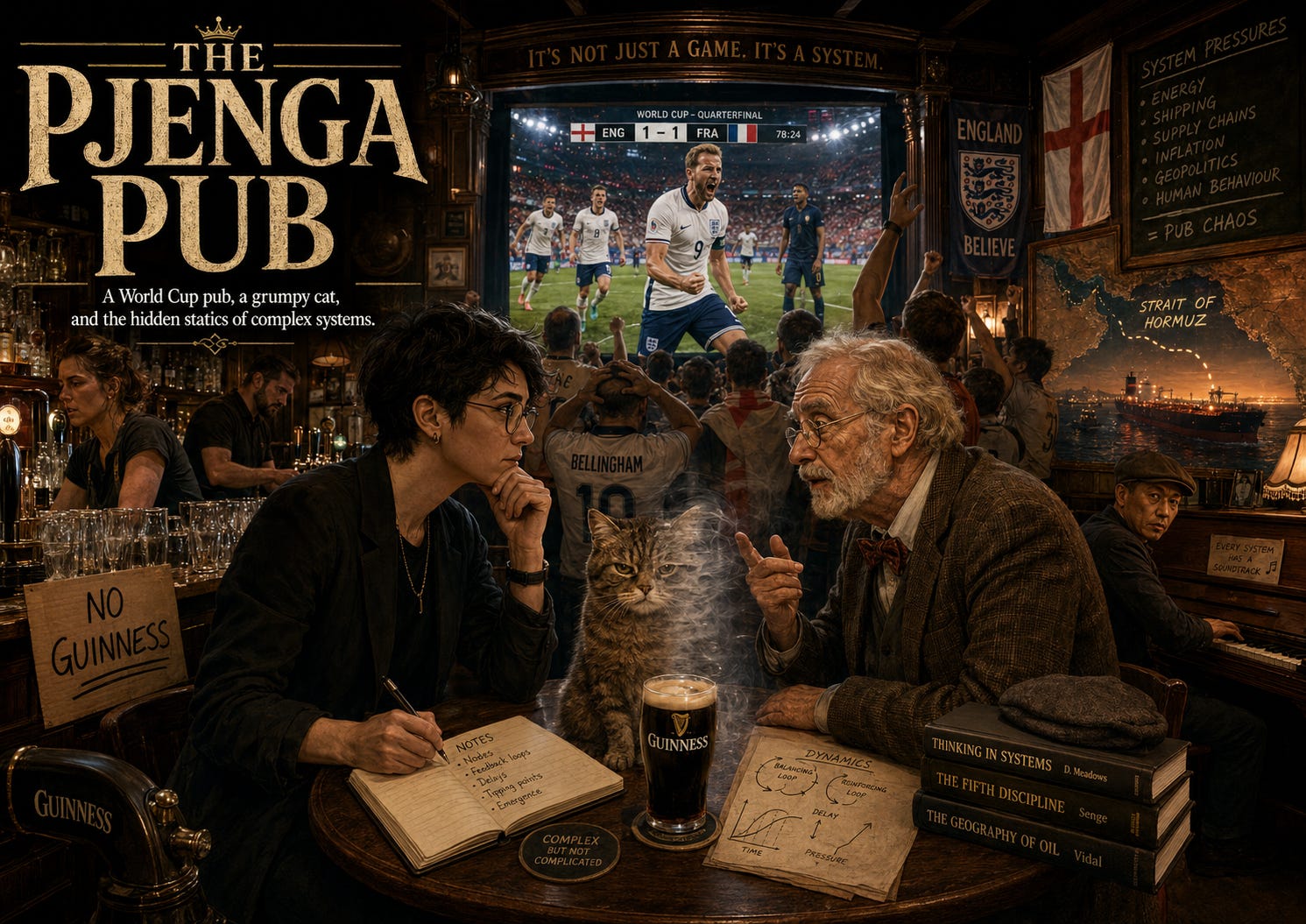
Professor Heisenberg and the inventor of the PJenga method walk into a pub. The landlord is merely puzzled by the distinctly grumpy cat between them, whose outline never seems entirely in focus.
5.12 p.m. — Before the match
When Ike entered the pub, the world was still in order.
At least, it looked that way.
A projection screen hung above the small live-music stage, where it clearly did not belong. Two black straps held it to a lighting rig, suspended between cables, spotlights and a faded sign that read:
LIVE MUSIC — THURSDAY TO SUNDAY
Today was Saturday.
There would be no band.
England were playing in the World Cup quarter-final.
The projector hummed above the entrance like an insect that already understood how important it was about to become. On the screen, the build-up programme was under way. Pundits stood in front of tactical diagrams, explaining formations as though the future were a neatly divided football pitch.
In one corner, a pianist sat at a black upright and played something quiet that sounded vaguely like Cole Porter.
The landlord polished glasses.
Two members of staff pushed tables together.
From the kitchen came the smell of hot fat, vinegar and warm expectation.
Professor Heisenberg was already sitting in the middle of the room.
An untouched pint stood in front of him.
On the chair beside him lay a cat.
Or at least something that, with sufficient probability, could be described as a cat.
Its head was sharply defined. The rest of its body dissolved into a grey uncertainty, as though whoever had rendered it had lost patience halfway through.
Only its expression was unambiguous.
It was grumpy.
“You’re late,” said Heisenberg.
Ike took off their coat.
“I’m twelve minutes early.”
“That merely proves that we measure time differently.”
The cat gave a low hiss.
“She doesn’t like physics jokes,” said Ike.
“She belongs to Schrödinger.”
“Tonight, she appears to belong to the pub.”
The landlord approached the table.
“What can I get you?”
Ike looked at the board behind the bar.
“A pint of Guinness.”
“Seven pounds twenty.”
Heisenberg raised an eyebrow.
“For beer?”
“For that beer.”
“What’s the difference?”
“Twenty pence,” said the landlord, and walked away.
Heisenberg looked at Ike.
“Well?”
“Well what?”
“Seven pounds twenty. Why?”
Ike picked up the menu without reading it.
“What do you think?”
“The landlord expects a full house. England are playing. Demand rises. He puts the price up.”
“That is the visible layer.”
“It is also the obvious explanation.”
“Obvious is often just another word for the first explanation that remains standing.”
The cat raised one ear.
Ike pointed towards the price board.
“The price does not begin there.”
“Where, then?”
“In the cellar. On the road. In a delivery lorry. At a refinery. On a tanker. Perhaps in the Strait of Hormuz.”
Heisenberg glanced towards the window.
“That is rather a long way from here.”
“Only geographically.”
5.28 p.m. — The first layer of the onion
The Guinness arrived.
The landlord placed it on the table with a movement that was both practised and faintly offended.
The drink settled slowly.
Dark below.
Cream above.
“Look at it,” said Ike. “What do you see?”
“Beer.”
“You see the final product of a very long chain.”
“I see a drink.”
“Exactly. That is the problem.”
Heisenberg leant back.
Ike began to count.
“Barley. Water. Energy. Glass. Metal kegs. Refrigeration. Transport. Staff. Rent. Insurance. Tax. Card-processing fees. Maintenance. Waste disposal. Losses while pouring. Losses in storage. Broken glassware. And tonight, on top of all that, technical equipment, broadcasting rights, extra staffing and perhaps security.”
“The landlord still decides the price.”
“Yes. But not freely.”
“He could charge six pounds.”
“Then he might not cover his costs.”
“Or eight.”
“Then fewer people might come.”
“So he optimises.”
“He balances.”
“That sounds less mathematical.”
“It is more realistic.”
The pub was beginning to fill.
Two men in white England shirts took the table next to theirs.
A family sat near the door.
Three women ordered alcohol-free beer and fish and chips.
A group of young men moved two bar stools without asking.
The landlord noticed.
He said nothing.
Not yet.
“The price,” said Ike, “is the visible surface of a system. People see it and look for someone to blame. Usually the person who announces it.”
“The landlord.”
“Even though part of the burden may have arisen thousands of miles earlier.”
“Hormuz.”
“Possibly.”
“You say possibly rather often.”
“Because certainty is not a virtue when the evidence does not support it.”
The cat licked a paw that became fully visible for a moment before fading back into shadow.
5.46 p.m. — The tanker that never reached the bar
“Let us suppose,” said Ike, “that a tanker cannot pass through the Strait of Hormuz as planned.”
“Because it is closed?”
“Perhaps it is officially open.”
“Then the tanker can pass.”
“Can it?”
“If the strait is open.”
“Physically, perhaps. But what about insurance? War-risk premiums? Delays? Naval escorts? The possibility of seizure? Port capacity? Crew availability? Charter rates?”
Heisenberg looked towards the television above the bar. England supporters outside the stadium were singing.
“So the strait is both open and not open.”
“Precisely.”
“Schrödinger’s strait.”
The cat growled.
“She thinks that is a poor metaphor.”
“She benefits from it.”
Ike took a sip.
“The tanker arrives late. Refined fuel becomes more expensive. Diesel may rise faster than crude oil because refinery capacity is limited or transport routes are under strain. The pub’s supplier pays more to run its lorry. A fuel surcharge appears on the invoice.”
“And the landlord raises the price of beer.”
“Or perhaps he orders fewer reserve kegs.”
“Why?”
“Because it is not only the delivery cost that rises. He may also expect fewer customers.”
“Because the beer is more expensive?”
“That too. But some customers come by car or taxi. If the journey costs more, some stay at home.”
Heisenberg thought for a moment.
“So the higher fuel price makes supply more expensive and reduces demand at the same time.”
“Supply side and demand side.”
“Then the landlord has to raise prices further, because fewer customers are covering his fixed costs.”
“And that may cause still fewer people to come.”
“A feedback loop.”
“A possible one.”
“Why only possible?”
“Because fewer customers may simultaneously relieve pressure on the taps, the kitchen, the toilets and the staff. The evening may become financially weaker but operationally more stable.”
Heisenberg looked around the room.
“That is unsatisfactory.”
“Complex systems are under no obligation to be aesthetically satisfying.”
The pianist moved into a livelier tune.
A man at the bar began tapping his foot.
6.03 p.m. — The man at the piano
“Why is the pianist playing?” asked Heisenberg.
“Because he was booked.”
“But there is football tonight.”
“The landlord appears to have made that decision later.”
“Then the pianist is unnecessary.”
Ike looked towards the corner.
He was a thin man with grey hair. He played quietly enough not to interrupt conversation, but firmly enough to hold the room together.
“Perhaps he is the most important person here.”
Heisenberg laughed.
“The landlord owns the pub.”
“Ownership and load-bearing function are not the same thing.”
“You are turning a pianist into a system node.”
“The system has already done that.”
“How?”
“He regulates the baseline mood. If the stream fails, he can fill the silence. If England win, he can channel the euphoria. If England lose, he can avoid playing the wrong song.”
“And if he does play the wrong one?”
“Then a culturally harmless stimulus may become a trigger inside an already stressed system.”
Heisenberg studied the musician.
“He does not look dangerous.”
“Critical infrastructure rarely looks dangerous. It looks ordinary.”
The cat turned on the table and nearly knocked over the pint.
Ike caught it.
“Good example,” they said.
“Of what?”
“Of a loss that was prevented, and will therefore never appear in any statistics.”
6.21 p.m. — The people nobody sees
Orders began to multiply.
A waitress balanced six glasses on a tray.
A younger colleague stood at the till, trying to locate a reservation, complete a card payment and answer a question about allergens at the same time.
“Who carries the pub?” asked Ike.
Heisenberg nodded towards the landlord.
“He does.”
“Why?”
“He makes the decisions.”
“And who notices that table seven has ordered for the third time without paying?”
Heisenberg glanced over.
“The waitress.”
“Who notices that the man by the window is becoming increasingly aggressive?”
“Presumably the waitress again.”
“Who sees that the older woman by the door has gone pale?”
“She does.”
“Who knows there are only three Guinness kegs in the cellar that are cold enough to serve?”
“I don’t know.”
“Perhaps only she does.”
The waitress passed their table, collected an empty glass, warned a customer about a wet patch on the floor and gave the pianist a brief nod.
He changed to a calmer piece.
“She is waiting staff,” said Heisenberg.
“She is a sensor network, a communications hub, an early-warning system, a flow regulator and the pub’s informal memory.”
“And if she goes down?”
“Then the system does not merely lose a pair of hands. It loses perception.”
Heisenberg fell silent.
“PJenga,” said Ike, “does not begin by asking who appears powerful. It asks who is actually carrying the load.”
6.47 p.m. — In the cellar
The landlord disappeared through a door behind the bar.
A moment later, something metallic clanged below.
“What is happening down there?” asked Heisenberg.
“That is a very good question.”
“You don’t know.”
“Exactly.”
“And yet you are analysing it.”
“Analysis often begins by correctly identifying what one does not know.”
Beneath the pub lay:
-
kegs,
-
pipes,
-
gas cylinders,
-
refrigeration units,
-
circuit breakers,
-
spare parts,
-
stock,
-
perhaps a second router,
-
perhaps a damaged pressure regulator,
-
perhaps an inventory sheet that had not been updated since Thursday.
Nobody upstairs was talking about any of it.
Upstairs, the pre-match coverage continued.
Upstairs, pints were ordered.
“The cellar is the foundation,” said Ike. “It is not invisible because no one could see it. It is invisible because no one looks while it continues to work.”
“And when it stops working?”
“Then it moves from background scenery to principal character in a matter of seconds.”
The landlord reappeared.
“Everything all right?” called the waitress.
“Yes,” he said.
He said it too quickly.
The cat stared at the cellar door.
7.02 p.m. — Kick-off
The lights were dimmed.
The pianist played the final bars, stood up and pushed his stool aside. He remained in his corner. The landlord had apparently promised him a seat.
The teams walked out on the screen.
The pub was now almost full.
Everything still worked.
The taps flowed.
The kitchen functioned.
The card machines beeped.
The internet held.
The projector was in focus.
The cat was not.
“Now,” said Heisenberg, “the system is under strain.”
“Not much yet.”
“The room is full.”
“Fullness is not a diagnosis of strain.”
“What is?”
“How close the system is operating to its capacity limits. How many buffers remain. How quickly it can adapt. Which nodes are being used simultaneously.”
The first minute began.
The pub fell silent.
“Information,” said Ike, “is now the most important material in the room.”
“A football match is not material.”
“A ball is about to cross a line thousands of miles away. Within seconds it will change drinking speed, noise levels, ordering patterns and perhaps the likelihood of violence in this room.”
Heisenberg looked at the screen.
“Then information has physical effects.”
“As soon as it changes behaviour.”
7.17 p.m. — The first goal
England scored.
The pub exploded.
Chairs scraped. Glasses tipped. People leapt to their feet, shouted and embraced strangers. The pianist laughed and slapped the closed lid of the piano.
Then something less spectacular happened.
Nearly everyone ordered at once.
The staff moved faster.
Four taps opened.
A new wave of food orders hit the kitchen.
A glass shattered.
Someone ordered five whiskies.
The card terminals worked continuously.
“Do you see?” asked Ike.
“Euphoria.”
“A load impulse.”
“That sounds rather joyless.”
“It is not a moral judgement. The goal produces revenue and strain at the same time.”
“So it is good and bad.”
“For whom? Over what period? In which subsystem?”
Heisenberg sighed.
“You ruin simple pleasures.”
“No. I merely explain what carries them.”
The cat had retreated beneath the table.
7.29 p.m. — Function is not proof
The pub continued to operate.
The waitress helped her colleague at the till.
The landlord began pulling pints himself.
The pianist picked up two overturned bar stools.
One customer held the kitchen door open so a tray could pass through.
“You see,” said Heisenberg. “The system adapts.”
“Yes.”
“Then it is resilient.”
“Perhaps.”
“What is missing this time?”
“The question of how the adaptation is being paid for.”
The landlord abandoned another task.
The waitress worked faster.
The pianist helped without being paid.
A customer briefly assumed an operational role.
“The pub remains functional,” said Ike. “But only through improvisation, additional labour and informal assistance.”
“That is a good thing.”
“In the short term. If those same people are exhausted later, the reserve will be missing when the next impulse arrives.”
“So function is not proof of resilience.”
“Sometimes function is merely the visible consumption of a buffer.”
7.41 p.m. — The second goal
England scored again.
This time the roar was louder.
But the second goal did not strike the same pub as the first.
Several customers had already consumed two or three drinks.
The staff were faster, but less focused.
The kitchen was behind.
Empty glasses stood on three tables.
The floor in front of the bar was sticky.
Again, several taps opened at once.
The Guinness began to pour more slowly.
“The pressure’s dropping,” said the landlord.
“Then increase it,” said Heisenberg.
The landlord gave him a look that made it clear that Nobel Prizes carried limited authority behind a bar.
Ike pointed towards the taps.
“It may not be only the pressure.”
“What else?”
“Gas supply. Regulator. Temperature. Pipe length. Simultaneous flow. Kegs that are too warm. Refrigeration capacity. Foam loss. Staff speed.”
“But it is still pouring.”
“At what rate? With how much waste? For how long?”
A pint emerged nearly half foam.
The landlord put it aside and started again.
“Now he is losing beer, time and capacity simultaneously,” said Ike.
“But there are more kegs downstairs.”
“Stock is not supply.”
7.52 p.m. — Three goals in eleven minutes
The third goal came sooner than anyone had expected.
The room shook.
More orders.
More glasses.
Four taps open again.
The Guinness tap coughed.
It spat foam and air.
The landlord swore and disappeared into the cellar.
“Now the beer has run out,” said Heisenberg.
“Perhaps not.”
“What else could it be?”
“The system’s ability to transform demand into supply.”
The cat reappeared on the table. Only its head was visible. It stared at a half-filled glass.
“The third goal is the same event as the first,” said Heisenberg.
“No.”
“A goal is a goal.”
“The first goal struck a system with full stock, sober customers, fresh staff and a clean floor. The third strikes a system that has already been altered.”
Heisenberg looked towards the bar.
“Cumulative strain.”
“Chronodynamics.”
“The same event produces a different effect later.”
“Because it never strikes the same system twice.”
8.01 p.m. — Half-time
The first half ended.
For a few seconds, the pub appeared to breathe out.
Then nearly everyone stood up at once.
The toilets filled.
The kitchen received another surge of orders.
People crowded the bar.
Staff cleared tables.
The landlord changed a keg.
The pianist returned to the piano and began to play.
“Now the system can recover,” said Heisenberg.
“No.”
“The match has paused.”
“The burden has moved.”
From the screen to the bar.
From the bar to the kitchen.
From the tables to the toilets.
From the audience to the staff.
From spectacle to supply.
“A pause is not necessarily recovery,” said Ike. “Sometimes only the overloaded part changes.”
The pianist played something brisk.
Some of the customers began clapping along.
“Too fast,” said Ike.
“What?”
“The piece.”
“It raises the mood.”
“The mood is already high.”
The pianist noticed the room becoming more restless. After a few bars, he shifted into something slower.
Heisenberg watched him.
“He noticed.”
“Adaptive control.”
“Without being instructed.”
“Informal systems often react more quickly than formal ones.”
8.14 p.m. — The last Guinness
The landlord came to their table.
“Just so you know, we’re running low on Guinness.”
Ike nodded.
A man at the next table overheard him.
“They’re running out of Guinness!” he shouted to his friends.
Within seconds, several groups ordered another round.
The landlord closed his eyes.
“The warning accelerated the shortage,” said Heisenberg.
“Information changes the system it describes.”
“A self-fulfilling shortage.”
“Partly. The shortage was real. But communication altered its course.”
The waitress brought two pints.
“Last guaranteed round,” she said.
“Guaranteed?” asked Heisenberg.
“The next keg is still too warm.”
Ike smiled.
“Formal reserve and usable reserve.”
The keg existed.
Yet it could not perform the function its existence appeared to promise.
8.27 p.m. — The second half
The match tightened.
England lost control.
The opposing side began to attack.
The pub became quieter, but not calmer.
People did not drink less.
They drank differently.
Short, nervous sips.
Orders placed without eye contact.
Hands wrapped more tightly around glasses.
“Now revenue falls,” said Heisenberg.
“Perhaps it rises.”
“Even though England are playing badly?”
“Anxiety consumption.”
“That is irrational.”
“No. It is merely not optimised for the landlord’s profit.”
The cat sat upright.
The pianist had stopped playing.
He was watching the room.
8.38 p.m. — No Guinness
The tap produced one final noise.
Then nothing.
The landlord hung a handwritten sign on a pillar:
NO GUINNESS — SORRY
At first, it was merely a stock problem.
Then it became a communication problem.
“How can a pub run out of Guinness during an England match?”
Then a trust problem.
“You simply didn’t order enough.”
Then a staffing problem.
Every order now required an explanation.
Then a throughput problem.
While staff explained the alternatives, they sold less of everything else.
Then a reputational problem.
Someone photographed the sign.
“The keg is empty,” said Heisenberg.
“Yes.”
“So my first diagnosis was correct.”
“The visible event, yes.”
“And the problem?”
“Has already migrated through five other systems.”
8.44 p.m. — Whisky for peace
The mood became sour.
Not violent.
Not yet.
A man slapped the bar with his hand.
Another began loudly insulting the landlord.
Two bar stools stood dangerously close to the piano.
The pianist gently lowered the lid.
The landlord made a decision.
“House whisky and selected single malts at special prices tonight!”
The room reacted immediately.
Grumbling became interest.
Orders were placed.
Some customers laughed again.
Heisenberg nodded.
“Problem solved.”
Ike looked towards the cat.
It had stopped hissing.
Its pupils were wide.
“No.”
“The customers are satisfied.”
“For the moment.”
“The landlord has substituted the product.”
“Technically.”
“What is missing?”
“Whisky is not a neutral replacement for beer.”
The customers absorbed more alcohol, more quickly.
The landlord lost margin.
The whisky stock fell.
Staff had to serve large numbers of individual glasses.
The queue remained.
“He is exchanging frustration for a faster rise in blood alcohol,” said Ike. “An immediate safety problem for a delayed one.”
“But if it works?”
“Then the emergency measure will be expected next time.”
The pianist began a gentle piece.
“And if it does not work?” asked Heisenberg.
A customer raised a bar stool.
Only to toast a friend.
“Then the piano discovers the supply chain.”
8.56 p.m. — The pianist as part of the safety architecture
England conceded.
The mood shifted.
Not completely.
But noticeably.
The pianist continued playing.
No anthem.
No taunting tune.
No triumphant melody.
Something steady and familiar.
The man with the bar stool put it down again.
“Coincidence?” asked Heisenberg.
“Possibly.”
“There it is again.”
“An analysis must distinguish between a plausible effect and claimed causation.”
“You believe the pianist is calming the room.”
“I observe that his playing coincides with the room becoming calmer. I have a plausible mechanism. But I cannot prove that a bar stool would have been thrown without him.”
“Then his contribution is not measurable.”
“Not directly.”
“So it is unscientific.”
“No. Merely difficult to quantify.”
The pianist glanced briefly towards Ike.
Perhaps he had been listening.
Perhaps not.
9.07 p.m. — The equaliser
The opposition scored.
The pub fell silent.
On the screen, people in different colours celebrated.
For three seconds, nothing could be heard except the projector and the refrigeration system.
Then several realities split apart.
Some customers swore.
Others stared silently at the screen.
One man asked for the bill at once.
Another group ordered more whisky.
A woman put on her coat.
“Now demand falls,” said Heisenberg.
“For some people.”
“And for others?”
“It rises.”
“Frustration drinking.”
“Or early departure. Or conflict. Or withdrawal.”
“The same goal produces different reactions.”
“Because customers are not a homogeneous mass.”
The cat jumped onto Heisenberg’s lap.
Only its weight was certain.
9.18 p.m. — Extra time
The match went into extra time.
The landlord had planned for ninety minutes.
So had the staff.
Now the period of peak load extended.
The kitchen had been due to close.
Some customers were approaching the time of their last train.
Security had only been booked until ten.
Staff began checking the clock.
“More football means more revenue,” said Heisenberg.
“And higher marginal costs.”
“Why marginal costs?”
“Because the extra half-hour does not fall upon a fresh system.”
Stock was depleted.
Staff were tired.
Customers were intoxicated.
The equipment had been running for hours.
The toilets needed cleaning.
The last trains were approaching.
“An extra half-hour can cost more than the first ninety minutes,” said Ike, “even though it is shorter.”
“Because the buffers are exhausted.”
“And because time is not neutral.”
9.31 p.m. — The frozen moment
At the decisive attack, the picture froze.
The ball hung in the air.
The goalkeeper was already moving.
Then everything stopped.
A collective groan passed through the room.
“No!”
Several customers reached for their phones.
The mobile network slowed.
One person shouted, “Goal!”
Another shouted, “Offside!”
A cheer came from outside.
Or perhaps it was a car horn.
The landlord stood beneath the projector, pressing the remote control as though determination alone might accelerate the flow of data.
Heisenberg stared at the screen.
“What happened?”
“We don’t know.”
“Some people know.”
“Some people believe they know.”
“That is the same thing.”
“Only if their source is correct.”
Several realities now existed in the same room:
-
England had scored.
-
England had not scored.
-
The goal had been disallowed.
-
The stream was merely delayed.
-
The match had already moved on.
-
Nobody knew anything.
The cat had disappeared entirely.
“Information asymmetry,” said Ike. “Not merely missing knowledge. Different actions based on different versions of reality.”
The pianist sat down.
He began the opening bars of We’ll Meet Again.
The room laughed.
The tension eased a little.
Then the picture returned.
No goal.
9.47 p.m. — The decision
England lost on penalties.
It happened quickly.
A whistle.
A shot.
A goalkeeper diving the wrong way.
Then celebration on the screen and silence in the pub.
The landlord had prepared for two possible futures.
For victory:
-
further bookings,
-
additional stock,
-
staff for the semi-final,
-
another night of using the stage,
-
more security,
-
more advertising.
For defeat:
-
an earlier finish,
-
surplus stock,
-
cancelled future revenue,
-
disappointed customers,
-
exhausted staff.
Now the second path had become real.
The additional whisky bottles were already open.
The warm Guinness keg remained in the cellar.
The pianist would not be needed for another England night.
The screen had still been hired.
“The result changed the future,” said Heisenberg.
“It decided which already-prepared burdens would become visible.”
“The reserves are now unnecessary.”
“Some of them.”
“Then they were a mistake.”
“Not necessarily. A buffer is always a wager on a possible future.”
“And if the future turns out differently?”
“The same buffer can become a burden.”
10.03 p.m. — After the match
The first customers left immediately.
Others stayed.
Some drank in silence.
One man blamed the referee.
Another blamed the manager.
A third blamed an individual player.
Responsibility travelled through the room until it attached itself to people far away who would never hear any of it.
The landlord did not switch off the screen.
Perhaps he hoped the post-match analysis would keep customers inside.
Perhaps he feared the silence.
The pianist played slowly.
The waitress placed water on several tables without being asked.
“Intervention,” said Heisenberg.
“Yes.”
“Free of charge.”
“Possibly good economics.”
“Because water is cheaper than the police.”
“Or a damaged piano.”
“Then she is the most important person in the room.”
“At this moment, perhaps.”
10.26 p.m. — The burden moves outside
Half the customers had gone.
Outside, only a few taxis were available.
Fares rose.
Some people complained about the cost.
Others tried to organise shared rides.
Two customers decided to order another drink because they had to wait anyway.
“So the high fuel price does not merely reduce customer numbers before the match,” said Heisenberg. “It also changes the way they leave.”
“And how long they stay.”
“And how much they drink.”
“And the safety risk.”
“And demand for taxis.”
“And the price of those taxis.”
Heisenberg looked at Ike.
“That is absurd.”
“No. Merely coupled.”
“How many more factors are you going to add?”
“Only those that genuinely alter the course of events.”
“How do you know which ones do?”
“By testing counter-hypotheses, discarding weak connections and refusing to turn every coincidence into causation.”
“That sounds less poetic.”
“Methodological discipline rarely is.”
The cat reappeared.
This time beneath the piano.
10.58 p.m. — What the customers do not see
Most of the tables were empty.
Now the after-load emerged.
Broken glasses.
A sticky floor.
Open whisky bottles.
Unpaid bills.
A damaged music stand.
Overtime.
A complaint on the landlord’s phone.
A video online:
ENGLISH PUB RUNS OUT OF GUINNESS DURING WORLD CUP DISASTER
What had ended for the customers was only now beginning for the pub.
“The event is over,” said Heisenberg.
“The match.”
“And the evening.”
“No.”
Staff cleared the room.
The kitchen counted stock.
The landlord checked the till.
The pianist ran his fingers over a new scratch on the piano.
“The end of an event is not the end of its burden,” said Ike.
“The burden merely becomes less visible.”
“Or moves into another time.”
Tomorrow:
-
exhaustion,
-
cleaning,
-
restocking,
-
accounts,
-
complaints,
-
staff conversations,
-
an insurance claim.
Next week:
-
revised prices,
-
new supplier contracts,
-
different staffing plans,
-
perhaps no more public screenings,
-
perhaps even more of them.
11.37 p.m. — The last customer
The final customer put on his coat.
“Shame,” he said to the landlord. “Still, good evening.”
The landlord smiled wearily.
“Thank you.”
The door closed behind him.
Now only the following remained:
-
Ike,
-
Heisenberg,
-
the landlord,
-
the pianist,
-
the staff,
-
and the cat.
The staff left one by one.
The pianist packed away his music.
The landlord sat at a table with the evening’s accounts.
Eventually, he and the pianist left as well.
The lights remained dimmed.
Ike and Heisenberg were still seated in the middle of the room.
The cat jumped onto the table.
For the first time that evening, it was almost entirely in focus.
Heisenberg looked around the empty pub.
“Now it is stable again.”
Ike looked at the glasses, the floor, the silent taps and the darkened screen.
“No.”
“But no one is placing any further strain upon it.”
“The visible strain has gone.”
“What remains?”
“Depleted stock. Exhausted staff. Lost margin. New expectations. Unpaid bills. A damaged reputation. Perhaps better experience. Perhaps less trust. Perhaps a new plan.”
“Then a system never returns to its original state.”
“Not completely.”
“Chronodynamics.”
Ike nodded.
The cat lay down between them.
“And that,” said Heisenberg, “is PJenga?”
“Part of it.”
“Only part?”
“PJenga does not merely ask what happened. It asks what carried the process. Which burdens migrated. Which buffers bought time. Which interventions created new problems. Who adapted more quickly. What was visible. What remained in the cellar. And which future became more likely with every decision.”
“Then it is the art of seeing the invisible.”
“No.”
Ike looked towards the cat.
“It is a method for making visible what has been carrying the weight all along.”
Heisenberg lifted the final glass from the table.
“And the Strait of Hormuz?”
“It was here all evening.”
“In the Guinness?”
“In the delivery cost. In the number of customers. In the reserve planning. In the whisky. Perhaps even in the bar stool that was never thrown.”
The cat opened one eye.
“And is she alive?” asked Heisenberg.
Ike put on their coat.
“Which one?”
“The cat.”
Outside, a delivery lorry drove past.
Its engine sounded expensive.
Ike opened the door.
“Do not ask whether she is alive.”
“What should I ask?”
“Ask what it costs to keep her that way.”
The door closed behind them.
The pub was empty.
The screen was dark.
The piano remained.
And somewhere deep in the cellar, a keg of Guinness was cooling for a match England would never play.