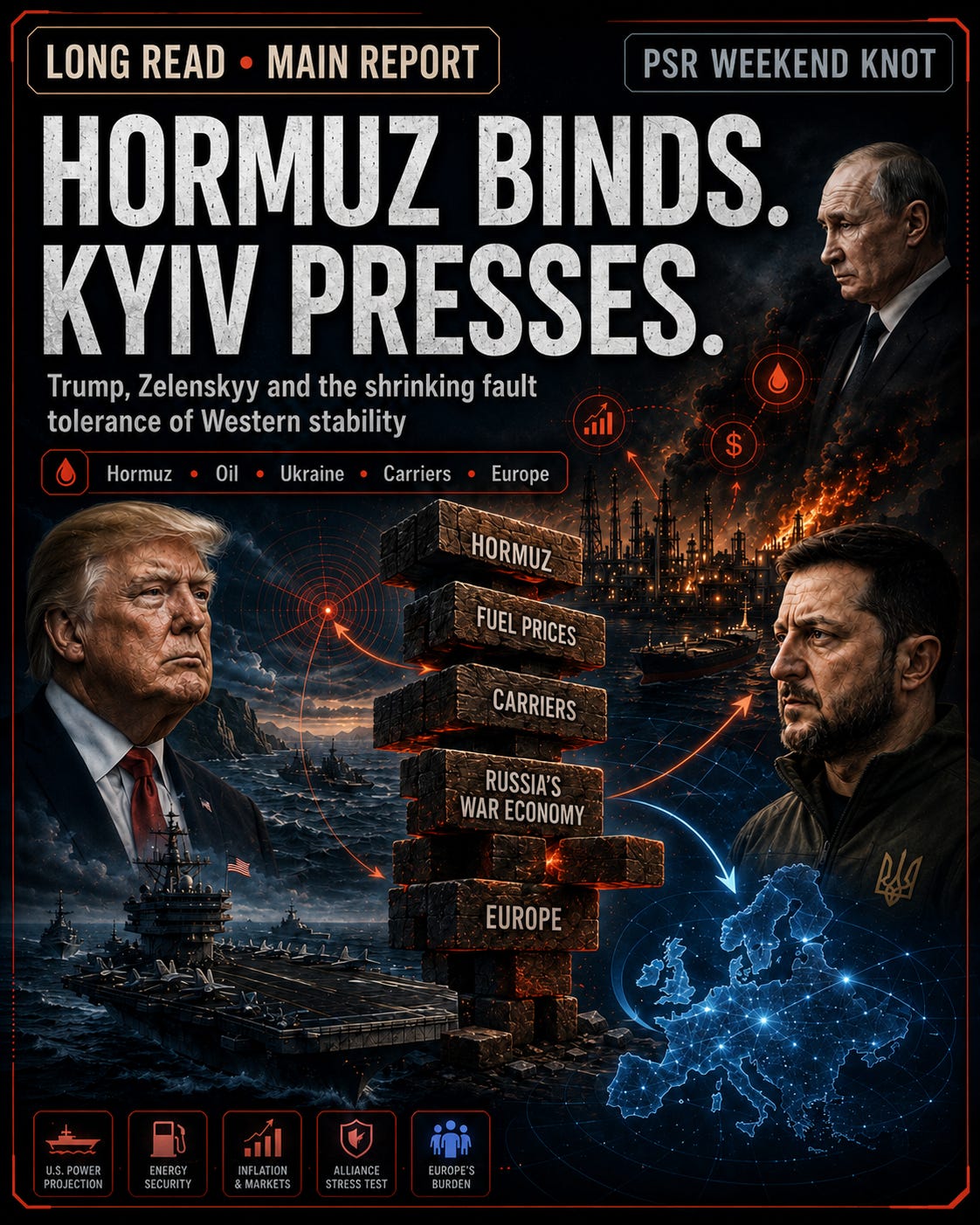
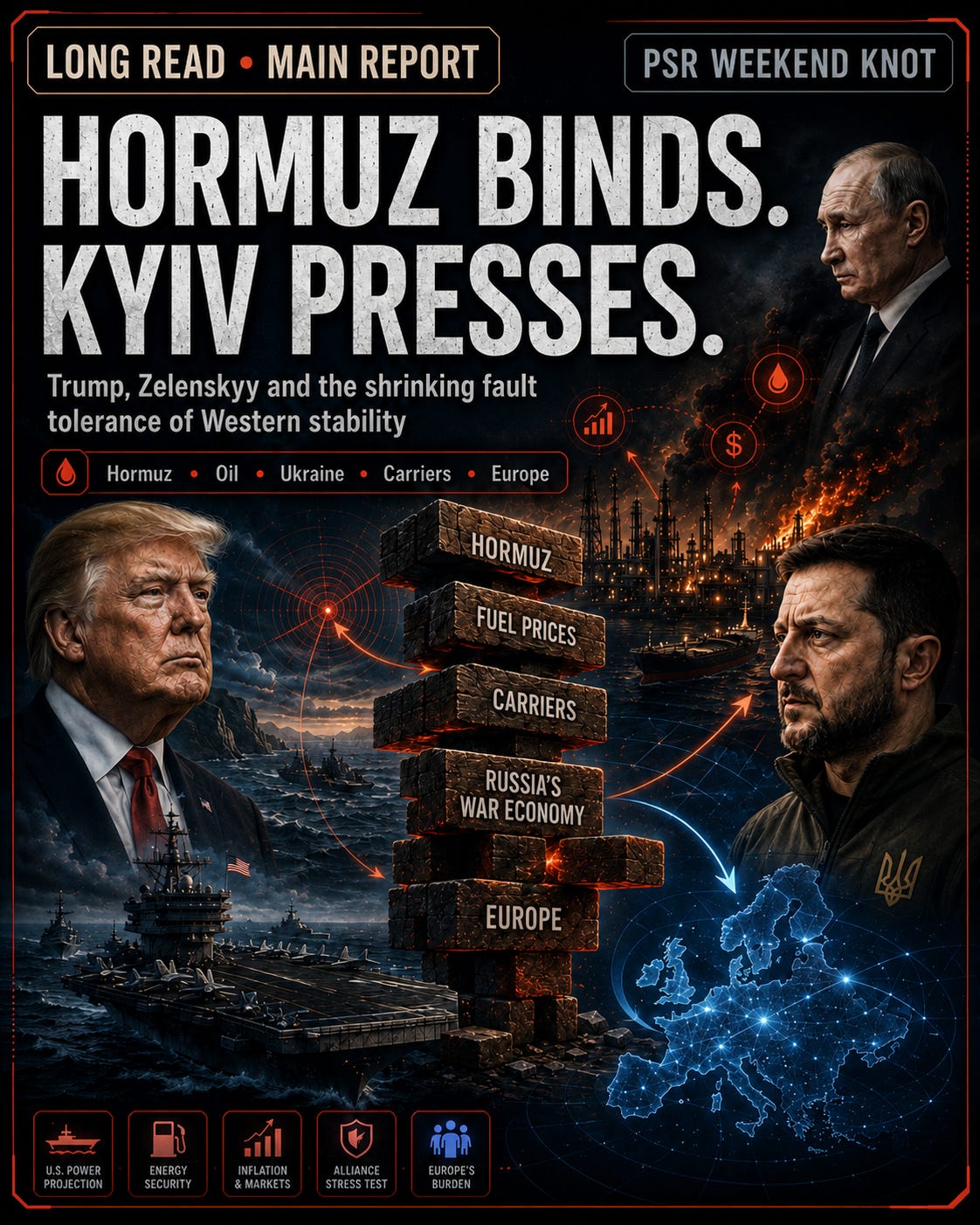
PSR Weekend Knot 16. & 17. May 2026 — Hormuz Binds. Kyiv Presses.
This is the detailed full-length PJenga Analysis long-read Article
Subtitle:
While Trump is under domestic pressure from high fuel prices, Iran binds U.S. capacity in the Middle East. Zelenskyy uses that exact window to increase friction inside Russia’s war economy. Europe is not merely watching: it is slowly being pushed into a load-bearing role for which Germany, the United Kingdom and NATO appear only partially prepared.
For the shorter but detailed explaining articles, use this Landing-Article to go forward:
Lead Thesis
In short:
This weekend does not show isolated crises. It shows active load transfer through the Western system.
Iran binds American power in the Middle East.
High fuel prices pressure Trump domestically.
Ukraine attacks the economic arteries of Russia’s war.
Europe would have to carry more responsibility.
But institutionally, politically and militarily, Europe is not becoming load-bearing fast enough.
The wrong sentence would be:
“Trump has an Iran problem, Zelenskyy has a Russia problem, Germany has a Bundeswehr problem, and Britain has a Labour problem.”
The better sentence is:
“The same loads are moving through different towers: energy, military capacity, domestic politics, alliance credibility, trust and time.”
This is the core of the weekend knot.
Not one crisis.
Not many unrelated crises.
But a linked stress system in which pressure migrates faster than institutions adapt.
Reading Aid
This PSR Spotlight reads the events of the weekend of 16–17 May 2026 not as a linear news sequence, but as structural statics.
It does not begin by asking:
What happened?
It asks:
Which load-bearing systems are being stressed?
Which buffers are real?
Which buffers are only facades?
Where is the system buying time instead of producing stability?
And which actors are adapting faster than institutions?
That is the purpose of PJenga.
PJenga does not treat geopolitics as a sequence of separate events. It treats it as a tower of interlocked systems. When one stone is moved, another tower may begin to carry more load. When a buffer leaks, another structure has to compensate. When a state projects strength in one theater, it may reveal where its power is currently tied down.
This weekend matters because several stones moved at once.
Hormuz.
Fuel prices.
U.S. carrier capacity.
Ukraine’s deep strike campaign.
Russia’s war economy.
British domestic politics.
German defense reform.
NATO’s actual damping capacity.
China’s ability to observe without acting.
The visible stories are different.
The structural question is one:
Does the Western system still have enough fault tolerance to absorb several coupled shocks at the same time?
1. Situation Picture: A Weekend with Several Stones Shifted
At first glance, the weekend’s reports seem far apart.
In the United States, Trump is under pressure because the Iran war and the Hormuz crisis have driven fuel prices higher for American consumers. According to the reporting reflected in the German original, the idea of temporarily suspending federal taxes on gasoline and diesel appeared as a reaction to national average gasoline prices around 4.52 dollars per gallon.
At the same time, the Strait of Hormuz remains the central energy nerve. Market reporting described rising oil prices amid fears of a prolonged Hormuz disruption, with Brent and WTI moving into politically dangerous territory.
The United States has shifted significant maritime capacity toward the Middle East. Reports referenced in the original describe U.S. carrier movements and the rerouting of naval mass away from other strategic spaces toward the Gulf. That matters because a carrier group is not merely a symbol. It is mobile military mass, command capacity, logistics, air defense, political signaling and escalation potential.
On the other side of the system, Ukraine continues to exploit Russia’s vulnerability in the energy tower. Large-scale Ukrainian drone attacks against Russia signal a pattern that is no longer limited to battlefield pressure. Kyiv is targeting the economic depth of Russia’s war: refineries, export logistics, energy flows, repair capacity, and the illusion that Russia’s hinterland is safe.
The original article also referred to earlier reporting suggesting that Ukrainian attacks had temporarily affected a significant share of Russian oil export capacity. Even if such numbers must be read cautiously and as snapshots, they point toward a strategic pattern: Ukraine is not only trying to hurt Russia at the front. It is trying to increase friction in the economic machinery that keeps Putin’s war going.
Meanwhile, the United Kingdom is politically strained. Brexit, Labour leadership dynamics and the question of strategic European positioning are reopening tensions. The issue is not merely party tactics. It affects Britain’s ability to function as a stable European security partner at a moment when Europe needs more damping, not less.
Germany, too, is moving — but movement is not the same as load-bearing capability. Defense reform, conscription debates, procurement, NATO targets and personnel restructuring all indicate that the German security tower is no longer asleep. But the reported promotion stop for senior non-commissioned officer ranks points to something deeper than administration: personnel trust, career pathways, military coherence and the middle backbone of the force.
PJenga-readable:
This weekend does not merely move separate news stones. It tests whether the Western order still has enough buffers to absorb several coupled loads at the same time.
2. Visible Trigger vs. Real Load
Visible Trigger
Five visible event lines define the weekend:
-
Trump is under pressure from high fuel prices.
-
Hormuz remains blocked, restricted, insecure or at least strategically unstable.
-
U.S. carrier and naval capacity is tied down in the Middle East.
-
Ukraine attacks Russia’s war economy through energy and export infrastructure.
-
Europe — especially Germany and the United Kingdom — must carry more load, but is not politically or institutionally free to move quickly.
That is the visible level.
It is what appears in headlines, market tickers, military reporting, policy debates and domestic political commentary.
But the visible trigger is not the same as the real load.
Real Load
The real load lies deeper.
The West must simultaneously:
-
dampen energy prices,
-
secure global sea lanes,
-
contain Iran,
-
weaken Russia,
-
support Ukraine,
-
deter China,
-
increase NATO capability,
-
maintain domestic legitimacy,
-
manage fuel-price anger,
-
sustain industrial production,
-
and preserve public trust.
That is no longer a normal multi-crisis environment.
It is a coupled statics test.
Not X, but Y:
Not:
“Several crises are happening at the same time.”
But:
“A system with shrinking fault tolerance has to redistribute several strategic loads at once.”
That is the difference between news accumulation and structural analysis.
The question is not simply whether each individual crisis can be managed. The question is whether the system can manage the interactions among them.
Can the U.S. stabilize Hormuz without driving oil prices higher?
Can Trump show strength without tying down too much U.S. capacity?
Can Ukraine pressure Russia’s war economy without creating additional energy-market instability?
Can Europe absorb more responsibility while its own institutions remain slow?
Can NATO remain credible when total mass is high but available damping is uneven?
This is where the weekend becomes a knot.
3. Stressed Tower: Energy
The energy tower is the most obvious stress point of this weekend.
Hormuz is not just another strait. It is a chokepoint through which a major share of global oil and LNG trade flows. If this passage is not free, safe or insurable, the consequences do not stop with shipping schedules.
They create secondary costs:
-
higher insurance premiums,
-
rerouting risks,
-
delivery delays,
-
political nervousness,
-
strategic reserve drawdowns,
-
higher consumer prices,
-
and domestic pressure on governments.
The critical stability stone is not only physical passage.
It is reliable passage at calculable cost.
That distinction is decisive.
A sea lane can be formally open and still be economically damaged. Tankers may continue to pass, but if insurers, shipping firms, refiners and traders treat the route as high-risk, the passage is already partially poisoned.
The wrong sentence would be:
“Trump has to open Hormuz militarily.”
The better sentence is:
“Trump has to stabilize Hormuz enough for markets to believe in calculable energy flows again.”
That is harder.
Markets do not react only to ships. They react to expectations, risk duration, escalation probability and credibility.
A carrier group can protect a route.
It cannot automatically lower insurance costs.
A threat can deter Iran.
It can also raise market anxiety.
A temporary tax pause can relieve consumers.
It cannot repair a damaged risk environment.
The energy tower therefore becomes the first central bridge between foreign policy and domestic politics.
Hormuz is not far away from Washington.
It reaches Washington through the pump.
4. Trump Under Pressure: Fuel Price as Domestic Ignition Point
From a PJenga perspective, Trump does not have a pure Iran problem.
He has a domestic-politics-through-energy problem.
The U.S. presidency is not judged only by foreign-policy strength. It is also judged by the price citizens see at fuel stations. Fuel prices are politically different from abstract inflation data. They are visible. They are repeated. They are emotional. They appear on signs along every road.
That makes gasoline a political sensor.
Stressed tower: U.S. domestic politics
Critical stability stone: everyday gasoline price
Load transfer: Hormuz → oil price → gasoline price → voter pressure → foreign-policy compulsion
Trump cannot simply wait out the Hormuz situation if the costs remain visible in everyday American life.
A president can rhetorically dominate abstract geopolitical risks. But high gasoline prices are not abstract. They become daily evidence that the outside world is imposing costs at home.
That is why “getting Hormuz free” is not just foreign policy for Trump. It is domestic damage control.
But this is also where the trap begins.
If Trump escalates too hard, risk and oil prices can rise further.
If he appears too soft, deterrence weakens.
If he uses only symbolic relief, markets may not believe him.
If he wants real stabilization, he needs Iran, Gulf states, insurers, shipping companies, refiners and Asian buyers to move into the same expectation space.
The immediate domestic necessity is not military victory.
It is market damping.
In PJenga terms:
Strength without market damping is not enough.
The political problem is that markets are not impressed by rhetoric alone. They price risk. They price time. They price credibility. They price the likelihood that the passage remains usable not only today, but next week, next month and under the next escalation signal.
Trump therefore has to solve two problems at once:
-
demonstrate control,
-
reduce the costs generated by the demonstration of control.
That is a difficult balance.
5. U.S. Carriers: Bound Power Is Shifted Power
The movement of American carrier groups toward the Middle East is militarily understandable.
But PJenga reads it as load transfer.
A U.S. carrier strike group is not merely a symbol. It is:
-
flight deck,
-
air defense,
-
strike capacity,
-
reconnaissance,
-
command structure,
-
escort ships,
-
logistics,
-
political signaling,
-
and escalation option.
When this mass is bound in the Middle East, it does not automatically disappear elsewhere. But it is no longer available with the same density, reserve function and reaction freedom.
Stressed tower: U.S. global power
Critical stability stone: simultaneous presence across multiple theaters
Load transfer: Indo-Pacific → Middle East
The point is not that the United States suddenly becomes powerless.
The point is that credible presence costs real mass.
A carrier deployed in one theater cannot provide the same reassurance, ambiguity or reaction capacity in another theater at the same time. Even if the United States remains globally unmatched, global power is not the same as unlimited simultaneous density.
The wrong sentence would be:
“The United States sends a carrier against Iran.”
The better sentence is:
“The United States shifts deterrence mass from a global priority theater into an acute crisis theater — and shows how thin multi-front deterrence has become.”
For China, this is not necessarily a starting signal.
But it is a measuring signal.
Beijing does not have to act immediately. It can observe.
How long do U.S. forces remain tied down?
How strained are ammunition and air-defense stocks?
How fast can the U.S. Navy rotate?
How nervous do Japan, Taiwan, the Philippines and Australia become?
How much additional load can Europe assume if Washington is distracted?
This is PJenga in pure form:
A stone is shifted in the Middle East, and the tower in the Indo-Pacific creaks with it.
The carrier is therefore not only about Iran.
It is about the distribution of American deterrence density.
6. Zelenskyy’s Window: Weakening Russia While Trump Is Bound
Zelenskyy cannot control the full strategic environment.
But he can use a window.
If Trump is bound in the Middle East and NATO appears politically, logistically or psychologically less dense, Putin may see a temptation: increase pressure on Ukraine, exploit Western distraction, reshape negotiation narratives, seek front-line advantages, intensify air terror, or test Europe’s endurance.
Kyiv’s counter-move is therefore logical:
Strike Russia where its war capacity connects to money, exports, energy and repair capacity.
Ukraine’s drone campaign is not just a spectacular series of explosions. It is a statics operation.
Russia does not finance its war only through tanks, soldiers and propaganda. It finances it through export revenues, logistics, refineries, ports, tankers, shadow fleets, insurance circumvention, discounts, intermediaries and Asian buyers.
If Ukraine creates friction there, it forces Russia into:
-
repairs,
-
rerouting,
-
higher security costs,
-
stronger air-defense binding in the hinterland,
-
export delays,
-
price discounts,
-
and political explanation work.
Stressed tower: Russian war economy
Critical stability stone: oil export logistics
Load transfer: front war → energy infrastructure → export revenue → budget pressure → war endurance
The wrong sentence would be:
“Ukraine is destroying Putin’s oil.”
The better sentence is:
“Ukraine is increasing friction in Putin’s war-financing machine at the very moment Russia might hope the West is distracted by Iran.”
Strategically, that is clean.
But it has a second side.
If Ukraine disrupts Russian export logistics while Hormuz is already tense, friction inside Russia’s war economy can also keep the global energy price nervous.
That is not an argument against Ukraine’s strategy.
It is PJenga sobriety:
A correct strike against Russia can still create side-loads in the global energy system.
In PJenga, moral clarity and structural consequence are not the same thing. A strike can be strategically justified and still produce secondary load elsewhere.
That is exactly why this weekend is a knot.
7. Russia: Putin Does Not Necessarily Lose Immediately, but His Buffers Become More Expensive
Putin is not facing a simple economic collapse.
Russia has shown adaptability:
-
shadow fleets,
-
price discounts,
-
alternative routes,
-
authoritarian cost transfer,
-
repression,
-
propaganda,
-
trade rerouting,
-
and military improvisation.
But adaptability is not the same as stability.
A system can continue functioning while becoming more expensive, brittle and dependent on coercion.
What appears stable from the outside may be hollow inside.
Russia’s war economy still produces, exports, mobilizes and attacks. But it increasingly has to repair, secure, reroute and explain.
A damaged export port is not just a local explosion. It is evidence that Russia can no longer treat its energy infrastructure as untouchable hinterland.
A hit tanker is not just a ship. It is a signal to insurers, shadow-fleet operators, port logisticians and buyers.
An attacked refinery network is not only fuel loss. It is pressure on air-defense allocation.
PJenga-readable:
Ukraine forces Russia to pull protection load from the front into the depth.
This matters.
Every Russian air-defense system protecting refineries, ports, tank farms or export terminals is not fully available for other priorities: the front, cities, command nodes or troop concentrations.
Load transfer: Ukrainian drones → Russian hinterland → air-defense binding → cost increase → lower operational freedom
Putin can absorb damage.
But not for free.
And this is the key point: authoritarian systems can hide cost, shift cost, repress cost, distribute cost and lie about cost. They cannot abolish cost.
Russia’s apparent stability may therefore be real resilience — or authoritarian forced cost transfer. PJenga does not confuse the two.
The question is not only whether Russia continues fighting.
The question is:
How expensive does every additional week of war become?
8. Europe: The Load Arrives Before the Structure Is Ready
If the United States is bound by Iran and Hormuz, Europe must assume more responsibility.
That has been clear for years.
But this weekend shows again: the situation is accelerating faster than European institutions.
The United Kingdom remains militarily relevant. It is nuclear-armed, intelligence-strong and central to NATO. But domestically it is fragile. Labour leadership tensions, Brexit inheritance and strategic EU positioning affect Britain’s ability to remain a stable damping actor.
Stressed tower: British strategic damping
Critical stability stone: domestic leadership capacity
Load transfer: cost crisis / Brexit question → party conflict → government room for maneuver → European security capacity
Britain can help militarily.
But political instability makes every long-term load assumption more expensive.
Germany, meanwhile, is moving. That is real.
Defense reform, conscription debate, new structures, rhetoric of war-readiness, procurement, NATO goals, personnel expansion — there is movement in the system.
But is it enough?
In short: Not yet, if the situation escalates faster than German administrative and personnel statics can carry.
The Bundeswehr does not only need more money and equipment.
It needs:
-
trust in the non-commissioned officer corps,
-
functioning career pathways,
-
reserve registration,
-
training capacity,
-
ammunition stocks,
-
digital command capability,
-
air defense,
-
drone defense,
-
medical and logistics chains,
-
and political honesty toward the population.
A promotion stop for key NCO ranks might be an administrative issue in quiet times.
In this situation, it becomes a trust stone.
The wrong sentence would be:
“The Bundeswehr is reorganizing promotions.”
The better sentence is:
“Germany is trying to make the defense tower more load-bearing, but may damage trust in the middle backbone of the force while doing so.”
Not dramatic in the sense of immediate collapse.
But relevant as a hollow space.
Germany has economic mass.
But mass is not deployable capability.
Wealth is not readiness.
Announcements are not units.
Budgets are not ammunition.
Reform language is not trust.
Europe’s load problem therefore becomes especially visible in Germany.
9. NATO Weakness: Not Lack of Strength, but Lack of Damping
When people say NATO is weakening, precision matters.
NATO is not weak in an absolute sense. It has enormous economic, technological, military and industrial capacity.
But it has a damping problem.
Damping means:
How much additional load can a system absorb without becoming internally unstable politically, logistically or organizationally?
That is where the problem lies.
The United States is globally bound.
Germany is rebuilding.
The United Kingdom is politically nervous.
France has military substance, but its own political tensions.
Eastern Europe is threat-aware, but not large enough to carry alone.
The EU can coordinate, but often more slowly than crises escalate.
Ukraine is highly adaptive, but constantly consumes people, material and air defense.
Not:
“NATO is weak.”
But:
“NATO has high total mass, but unevenly distributed, politically difficult and temporally slow load-bearing capacity.”
That is more dangerous than simple weakness.
Because it creates apparent stability.
On paper, there is a great deal of power.
In reality, it must be available in time, compatible, logistically supported and politically sustainable.
That is the difference between total mass and deterrence density.
Total mass asks:
How much does the alliance possess overall?
Deterrence density asks:
How much can the alliance credibly bring to the right place, at the right time, in the right form, under political conditions that can be sustained?
This is the actual NATO problem of the weekend.
The alliance is not empty.
But the system must prove that its strength is not only aggregate, but available.
10. Narrative vs. Real Statics
Narrative 1: “Trump must show strength.”
Real statics:
Trump must not only show strength. He must break the energy-price expectation without generating a larger war.
Too much hardness can drive oil prices further.
Too little hardness can embolden Iran.
Too much symbolism can disappoint markets.
Too much military binding weakens other theaters.
PJenga-readable:
Strength without market damping is not enough.
Narrative 2: “Ukraine is using the West’s distraction.”
Real statics:
Ukraine is not using distraction. It is preventing Russia from using distraction.
Kyiv forces Moscow to fight the war not only at the front, but inside its own economic depth.
PJenga-readable:
Ukraine shifts pressure into Russia’s financing tower.
Narrative 3: “Hormuz must be open.”
Real statics:
Open is not enough. Hormuz must be safe, predictable, insurable and politically credibly stabilized.
PJenga-readable:
Physical openness without restored trust is only a buffer facade.
Narrative 4: “Germany is finally moving.”
Real statics:
Yes, but movement is not automatically load-bearing capability.
Germany can decide many things. The question is whether decisions become units, trainers, ammunition, reserves, command capability and trust in time.
PJenga-readable:
Reform speed must overtake load growth. Otherwise it remains time-buying.
Narrative 5: “Russia holds out.”
Real statics:
Russia can absorb a great deal, but every absorbed damage has a cost. The question is not only whether Russia continues fighting, but how expensive each further week becomes.
PJenga-readable:
Stability can be real resilience — or authoritarian cost transfer.
11. PJenga Extended Layer
Visible Agents
The visible agents in this weekend knot include:
-
Trump,
-
Zelenskyy,
-
Putin,
-
Iranian leadership,
-
U.S. Navy / CENTCOM,
-
NATO governments,
-
the German government and defense ministry,
-
Labour leadership in the United Kingdom.
These actors dominate headlines.
But headlines do not carry the whole system.
Invisible or Semi-Visible Agents
More important in some cases are the invisible and semi-visible agents:
-
insurers,
-
shipping companies,
-
oil and LNG traders,
-
refinery operators,
-
shadow-fleet networks,
-
ammunition planners,
-
air-defense logisticians,
-
non-commissioned officer corps,
-
voters angry about fuel prices,
-
Chinese strategic observers,
-
financial markets,
-
energy-intensive industries,
-
budget planners in Western governments.
These actors matter because many of them move faster than governments.
Insurers price risk faster than parliaments debate.
Shipping companies reroute faster than ministries publish strategy papers.
Voters feel fuel prices faster than they accept foreign-policy explanations.
Drone operators adapt faster than procurement offices.
Markets lose trust faster than diplomacy can rebuild it.
Which actors adapt faster than institutions?
Almost all actors that are operationally driven or market-driven.
That is the hollow space of modern democracies:
They have high legitimacy, but often low reaction speed.
This does not make democracy weak. It means democratic systems need better crisis acceleration channels that do not destroy their legitimacy.
That is the hard task.
12. Buffers vs. Real Stability
Real Buffers
There are real buffers in the system.
U.S. naval capacity remains considerable.
Strategic reserves can dampen short-term pressure.
Ukraine has high drone adaptability.
Europe has enormous economic mass.
NATO remains a functioning alliance structure.
Russia is more vulnerable than its propaganda admits.
These are not illusions.
They matter.
They are why the tower still stands.
Buffer Facades
But several buffers are facades or partial facades.
“Hormuz is open” is not enough if passage remains expensive, risky or uncertain.
“Germany is raising defense spending” is not enough if personnel, training and procurement lag behind.
“The U.S. can be everywhere at once” is only partly true when carriers, ammunition and air defense are tied down in real theaters.
“Russia can absorb everything” hides rising repair, rerouting and protection costs.
“Britain is a stable security power” overlooks domestic fragmentation.
“NATO is strong” overlooks the difference between total mass and mass available in time.
In short:
Several systems look load-bearing because they still stand.
But they stand partly because they are buying time.
That is damaged normality.
Not collapse.
Not stability.
Time-buying.
13. Evidence Grades
This PSR framework uses evidence grades to keep analysis honest.
E1 — broadly confirmed / official or repeatedly supported
E2 — credible single-source or strong reporting
E3 — plausible indication, uncertain scope
E4 — analytical inference / scenario
E5 — speculative possibility, must be marked as such
U.S. fuel prices and domestic relevance
Evidence grade: E1/E2
Multiple media and market indicators support the basic pattern, though specific price figures vary by source and time.
Trump considering a temporary fuel-tax pause
Evidence grade: E2
Reported as a politically plausible response to fuel-price pressure.
Hormuz as a central oil and LNG chokepoint
Evidence grade: E1
Supported by energy agencies, market reporting and long-standing energy geography.
U.S. carrier capacity shifted toward the Middle East
Evidence grade: E2
Based on reporting about carrier movements and U.S. naval posture.
Ukraine intensifying deep strikes against Russia
Evidence grade: E1/E2
Supported by reporting and Russian claims, though Russian interception numbers require caution.
Ukrainian strikes significantly affecting Russian oil export capacity
Evidence grade: E2/E3
Reported through credible channels, but exact duration and magnitude remain uncertain.
Labour/Brexit leadership tensions affecting UK politics
Evidence grade: E2
Supported by contemporary political reporting.
Bundeswehr personnel and career-structure questions as security-relevant
Evidence grade: E2/E3
The structures are known; the precise strategic effect is not yet fully quantifiable.
China observing U.S. Middle East binding strategically
Evidence grade: E4
A plausible strategic inference, not evidence of a specific operational decision.
NATO damping capacity declining under multiple loads
Evidence grade: E4
Analytical synthesis from several simultaneous developments.
Evidence grading matters because PJenga does not aim to dramatize uncertainty into certainty. It separates confirmed facts, credible reports, plausible indicators and scenarios.
14. PJSI / PJIEF
PJSI — PJenga Stability Index
PJSI: 34/100 — damaged normality / low fault tolerance
There is no system break yet. There is no uncontrolled cascade. But several load-bearing towers are losing buffers at the same time:
-
energy,
-
U.S. domestic politics,
-
maritime deterrence,
-
Russia’s war economy,
-
European defense capability,
-
British political damping,
-
German Bundeswehr structure.
The system stands.
But it does not stand relaxed.
The PJSI is not lower because collapse is not visible. It is not higher because too many buffers are being consumed simultaneously.
This is the zone of damaged normality.
Things still function.
But they function with less reserve.
PJIEF — PJenga Interlock/Escalation Factor
PJIEF: very highly strained
Because load is actively moving between central towers:
Iran/Hormuz → oil price → U.S. gasoline price → Trump decision pressure
U.S. carriers → Middle East binding → Indo-Pacific damping loss → Chinese observation
Ukrainian drones → Russian oil logistics → Putin’s war financing → global energy market
NATO weakness perception → European load uptake → German defense reform
UK domestic politics → strategic uncertainty → European coordination weakness
This is not isolated.
This is coupled.
PJIEF is very highly strained because no single line remains contained within its own silo. Energy becomes politics. Military deployment becomes alliance structure. Ukrainian strikes become energy-market pressure. British domestic politics becomes European strategic damping. German administrative reform becomes NATO reliability.
That is the weekend knot.
15. Open Questions / Data Gaps
1. How free is Hormuz really?
The question is not only whether ships pass.
The key indicators are insurance premiums, waiting times, risk surcharges, shipping-company decisions and route adjustments.
Physical passage alone is not stability.
2. How long can Trump politically endure high fuel prices?
A temporary fuel-tax pause would be relief symbolism. It would not solve the supply and risk problem.
The crucial question is whether fuel prices remain visible enough to constrain foreign-policy choices.
3. How much are U.S. munitions and air-defense stocks being tied down by Iran?
Carriers are visible. Ammunition consumption is often the more critical stone.
A carrier can appear powerful while its operational ecosystem quietly consumes scarce interceptors, spare parts and logistics capacity.
4. How durable are Ukrainian hits against Russian oil export logistics?
A strike is a news item. Sustained capacity friction is statics.
The key indicators are repair time, rerouting costs, export delays, insurance effects and repeated vulnerability.
5. How does Putin react if his energy buffers continue shrinking?
Possible responses include more escalation against Ukraine, sabotage, pressure on NATO borders, internal repression or more aggressive information operations.
The question is not only what Russia loses, but how it compensates.
6. Is Germany truly accelerating — or rhetorically managing acceleration?
The difference between a structural paper and a deployable unit is the critical hollow.
Germany must be measured not by announcements, but by usable capacity.
7. How stable does Britain remain as a European security partner if Labour continues to slide internally?
The issue is not military incapacity. It is political focus.
Strategic load-bearing requires sustained attention. Domestic fragmentation reduces damping even when military assets remain real.
16. Next Shifts
1. Trump needs a Hormuz success, but not necessarily a military victory
The most likely next move is an attempt to stabilize Hormuz at least psychologically for the markets.
This could involve threats, deals, Gulf-state channels, indirect diplomacy, China, Oman, Qatar or temporary security arrangements.
Key indicator:
Falling insurance premiums matter more than Trump’s rhetoric.
2. Zelenskyy will continue working Russia’s energy and logistics tower
As long as Russia tries to exploit Western distraction, Ukraine will try to stress Russia’s war economy.
Key indicator:
Not only refinery hits matter. More important are ports, pumping stations, export terminals, tankers, rail logistics and repair times.
3. Putin may try to force attention
If Putin believes Trump is tied down in the Middle East, Russia may escalate to pressure Ukraine and Europe: air attacks, border provocations, drones near NATO edge states, disinformation or sabotage.
Key indicator:
More incidents along NATO’s eastern flank — especially Romania, Poland, the Baltics and the Black Sea.
4. Germany will be measured by the gap between announcement and implementation
The Bundeswehr debate will become harder. It will not only concern money, but personnel retention, career pathways, reserves, conscription feasibility and training capacity.
Key indicator:
Reactions from the troops, reservist organizations, Bundeswehr association, parliamentary defense oversight and budget committees.
5. Britain may dampen less strategically, even while remaining militarily important
If Labour leadership questions and Brexit narratives intensify, London may lose attention for international load-bearing.
Key indicator:
Whether EU/NATO policy becomes a domestic leadership weapon.
6. China does not have to do anything to benefit
If U.S. capacity remains tied in the Middle East for a long time, China can test how much deterrence density is missing in the Indo-Pacific through grey-zone activity.
Key indicator:
More pressure around Taiwan, the Philippines, the South China Sea, Japan or maritime militias — even without open military rupture.
Final Conclusion
In short:
The weekend of 16–17 May 2026 shows a dangerous simultaneity.
Trump must stabilize Hormuz because fuel prices in the United States generate political costs. Iran binds American power in the Middle East. This binding does not automatically weaken the United States, but it thins global U.S. deterrence density. Zelenskyy uses the window to prevent Putin from seizing the initiative and instead pressures Russia’s war economy through energy and export logistics. Europe would have to carry more load, but Britain is politically strained and Germany is rebuilding its defense statics more slowly than the situation creates load.
The wrong sentence would be:
“There are many crises right now.”
The better sentence is:
“There is one Western stability system with several load-bearing stones being shifted at once.”
Hormuz binds Washington.
Fuel prices bind Trump.
Carriers bind U.S. deterrence mass.
Ukraine presses Russia’s war-financing machine.
Russia absorbs damage, but at rising cost.
China watches the distribution of American attention.
Europe must carry more, but remains heavy, slow and institutionally complex.
NATO has mass, but damping is uneven.
The system has not broken.
But it has less reserve than it wants to admit.
PJenga-readable:
The tower still stands.
But several stones now carry more load than they were designed for.
And that is why this weekend matters.
Not because everything collapsed.
But because the costs of keeping everything upright became more visible.